EIFS
Exterior insulation and finish system (EIFS) is a general class of non-load bearing building cladding systems that provides exterior walls with an insulated, water-resistant, finished surface in an integrated composite material system. In Europe, systems similar to EIFS are known as External Wall Insulation System (EWIS) and External Thermal Insulation Cladding System (ETICS).
EIFS has been in use since the 1960s in North America, first on masonry buildings, but since the 1990s the majority on wood framed buildings. There is a history of water infiltration problems causing damage to buildings resulting in costly legal cases, so the recommended systems include a drainage plane to let water drain down and out from behind the cladding.
In the United States the International Building Code and ASTM International define Exterior Insulation and Finish System (EIFS) as a nonload bearing, exterior wall cladding system that consists of an insulation board attached either adhesively or mechanically, or both, to the substrate; an integrally reinforced base coat; and a textured protective finish coat.
EIFS with Drainage, another EIFS system, is the predominant method of EIFS applied today. As the name implies, EIFS with Drainage provides a way for moisture that may accumulate in the wall cavity to evacuate.
Although often called "synthetic stucco", EIFS is not stucco. Traditional stucco is a centuries-old material which consists of aggregate, a binder, and water, and is a hard, dense, thick, non-insulating material. EIFS is a lightweight synthetic wall cladding that includes foam plastic insulation and thin synthetic coatings. There are also specialty stuccos that use synthetic materials but no insulation, and these are also not EIFS. A common example is what is called one-coat stucco, which is a thick, synthetic stucco applied in a single layer (traditional stucco is applied in 3 layers).
EIFS are proprietary systems of a particular EIFS manufacturer and consist of specific components. EIFS are not generic products made from common separate materials. To function properly, EIFS needs to be architecturally designed and installed as a system. The materials and installation methods specified by different EIFS manufacturers are not all compatible and should not be used interchangeably in new construction or repair work.
The technical definition of an EIFS does not include wall framing, sheathing, flashings, caulking, water barriers, windows, doors, and other wall components. However, some architects have begun specifying flashings, sealants, and wiring fasteners as being a part of the EIFS scope of work, essentially requiring EIFS contractors to carry out that work as well. The technical national consensus standard for the definition of an EIFS, as published by ASTM International does not include flashing or sealants as part of the EIFS. Many of the EIFS manufacturers have their own standard details showing typical building conditions for window and door flashings, control joints, inside/outside corners, penetrations, and joints at dissimilar materials which should be followed for that manufacturers warranty.
Research, conducted by the Oak Ridge National Laboratory and supported by the Department of Energy, has validated that EIFS are the "best performing cladding" in relation to thermal and moisture control when compared to brick, stucco, and cementitious fiberboard siding. In addition EIFS are in full compliance with modern building codes which emphasize energy conservation through the use of CI (continuous insulation) and a continuous air barrier. Both these components are built into today's EIFS products to provide maximum energy savings, reduced environmental impact over the life of the structure, and improved IAQ, Indoor Air Quality. Along with these functional advantages come virtually unlimited color, texture, and decorative choices to enhance curb appeal and enjoyment of almost any home or structure.
EIFS before 2000 were barrier systems, meaning that the EIFS itself was the weather barrier. After 2000 the EIFS industry introduced the air/moisture barrier that resides behind the foam. In a study done by the Department Of Energy's Office of Science - Oak Ridge National Laboratory it was found that the best air/moisture barrier was a fluid barrier. The Oak Ridge National Laboratory, ATLANTA, Oct. 28, 2006 � EIFS "outperformed all other walls in terms of moisture while maintaining superior thermal performance." The National Institute of Standards and Technology (NIST) has evaluated the five life cycle stages of the environmental impact of EIFS alongside brick, aluminum, stucco, vinyl, and cedar. Depending on a variety of site and project specific conditions, EIFS have the potential to save money in construction costs and contribute toward energy efficient operations and environmental responsibility when correctly designed and executed.
EIFS have also passed a variety of fire tests that range from resistance to ignitability, that include: ASTM E 119, NFPA 268, NFPA 285, ANSI FM 4880.
Composition and types of EIFS
Types of External Wall Insulation Systems (EWIS)
Types of EIFS are defined by their materials and the existence/absence of a drainage plane. The EIFS Industry Members Association (EIMA) defines two classes of EIFS, Class PB (polymer based) identified as PB EIFS and Class PM (polymer modified) identified as PM EIFS.
PB EIFS is the most common type in North America and historically used expanded polystyrene (EPS) insulation adhered to the substrate with fiberglass mesh embedded in a nominal 1/16 inch (1.6 mm) base coat which can receive additional layers of mesh and base coat for stronger impact resistance. Other types of insulation board can include polyisocyanurate.
PM EIFS use extruded polystyrene insulation (XEPS), and a thick, cementitious base coat applied over mechanically attached glass fiber reinforcing mesh. The system has joints similar to traditional stucco. PM EIFS have evolved to include different insulation materials and base coats.
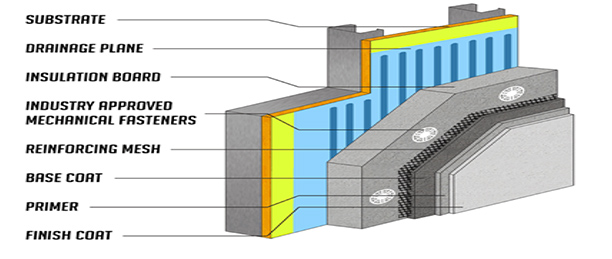
The most common type of EIFS used today is the system that includes a drainage cavity, which allows any and all moisture to exit the wall. EIFS with drainage typically consists of the following components:
An optional water-resistive barrier (WRB) that covers the substrate
A drainage plane between the WRB and the insulation board that is most commonly achieved with vertical ribbons of adhesive applied over the WRB
Insulation board typically made of expanded polystyrene (EPS) which is secured with an adhesive or mechanically to the substrate
Glass-fiber reinforcing mesh embedded in the base coat
A water-resistant base coat that is applied on top of the insulation to serve as a weather barrier
A finish coat that typically uses colorfast and crack-resistant acrylic co-polymer technology.
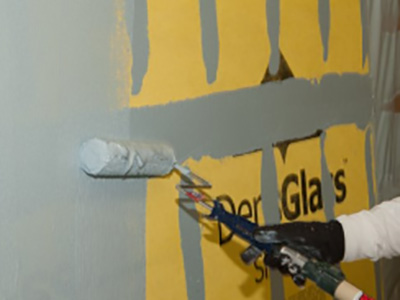
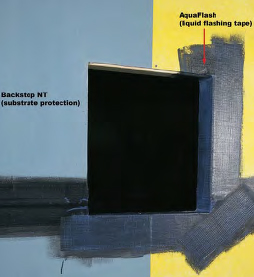
If an EIFS with Drainage, or water-managed EIFS is installed, a water resistive barrier (aka a WRB) is first installed over the substrate (generally glass faced exterior-grade gypsum sheathing, oriented strand board (OSB) or plywood).[citation needed] The moisture barrier is applied to the entire wall surface with a mesh tape over joints and a liquid-applied membrane or a protective wrap like tyvek or felt paper. Then a drainage cavity is created (usually by adding some sort of space between the foam and the WRB). Then the other 3 layers, described above, are added. This type of EIFS is required by many building codes areas on wood frame construction, and is intended to provide a path for incidental water that may get behind the EIFS with a safe route back to the outside. The purpose is to preclude water from damaging the supporting wall.
Adhesives and finishes are water-based, and thus must be installed at temperatures well above freezing. Two types of adhesives are used with EIFS: those that contain Portland cement ("cementitious"), or do not have any Portland cement ("cementless"). Adhesives that contain Portland cement harden by the chemical reaction of the cement with water. Adhesives and finishes that are cementless harden by the evaporation of water. Adhesives come in two forms: The most common is in a plastic pail as a paste, to which Portland cement is added and as dry powders in sacks, to which water is added. Finishes come in a plastic pail, ready to use, like paint. EIFS insulation comes in individual pieces, usually 2' x 4', in large bags. The pieces are trimmed to fit the wall at the construction site.